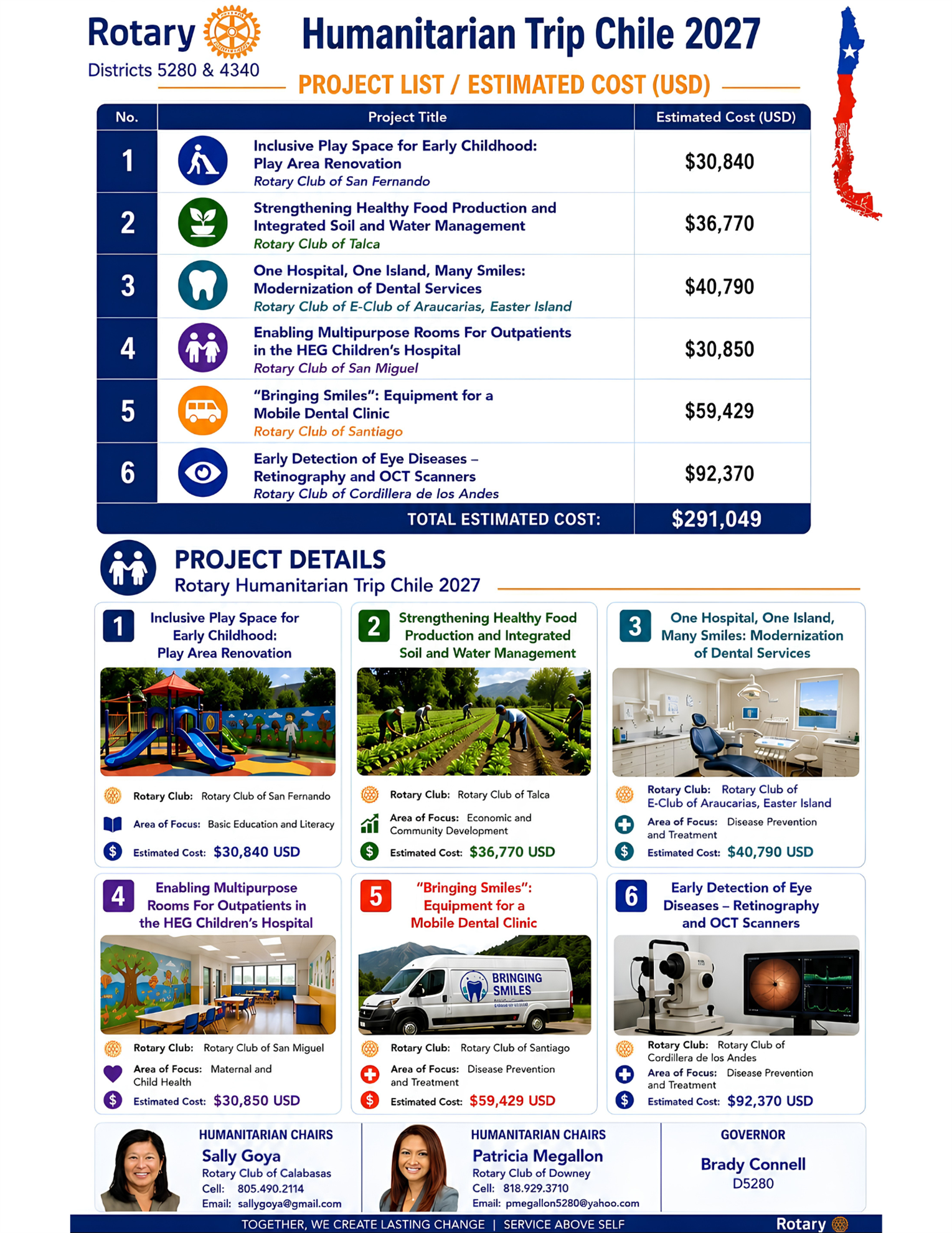
global grant project descriptions
- Rotary Club of San Fernando
- Area of Focus: Basic Education and Literacy
- Cost: $30,840 USD
Project Description:
The project seeks to implement an inclusive educational play space in the Early Childhood Education playground at the "Hermano Fernando de la Fuente" School. This special education institution has a 55-year history of serving students with intellectual and sensory disabilities, as well as those on the autism spectrum.
The Hermano Fernando de la Fuente School founded in 1969 serves students with various intellectual, sensory, and autism spectrum disabilities, prioritizing their holistic development, autonomy, and educational inclusion. The evaluation of students with autism spectrum disabilities requires education professionals specializing in special education.
Project Objectives:
- Enhance the comprehensive development, socialization, and safe recreation of students with disabilities through the creation of an inclusive play space adapted to their specific needs.
- Strengthen gross psychomotor development and physical coordination.
- Foster school integration and community coexistence
- Increase motivation, self-esteem, and emotional well-being
- Promote educational inclusion and equity
Primary Beneficiaries: The project is aimed at:
- 15 students in the Early Childhood Education level (ages 3 to 6) with permanent special education needs
- 86 students from other levels within the school
- Teachers, education assistants, and professionals from the multidisciplinary team
- Rotary Club of Talca
- Area of Focus: Economic and Community Development
- Cost: $36,770 USD
Project Description:
This project aims to strengthen the production of healthy, locally sourced food for self-consumption and the local market, thereby promoting food sovereignty. This project will focus on two communities - 100 families from rural communities in Pelarco, especially independent seniors who are part of neighborhood associations and senior citizens' clubs, belonging to vulnerable farming communities in rural areas. Implement sustainable farming practices with an agroecological approach at the family and community levels; and contribute to improving the physical and mental health of older adults through therapeutic gardens, which foster holistic well-being through contact with plants and nature. These therapeutic gardens promote not only physical activity but also socialization, cognitive stimulation, and stress and anxiety reduction, improving their quality of life and autonomy for the families. Thus, the project articulates a comprehensive approach that connects sustainable production, community health, and social strengthening in a highly vulnerable and distinctly rural area, generating a positive and lasting impact on farming families in Pelarco.
The second community impacts 20 family farms in Quebrada de Los Guindos. This project will incorporate sustainable integrated soil and water management practices to restore soil fertility and moisture absorption. Establish sustainably managed crops, considering intercropping between horticultural, fruit, and forest species with an agroforestry approach. Recover and reproduce endangered seeds and plants from the coastal drylands.
Project Objectives:
- Strengthen the production of healthy, locally sourced food for self-consumption
- Promote sustainable farming practices with an agroecological approach
- Contribute to improving physical and mental health of older adults
- Establish sustainable managed crops
- Recover and reproduce endangered seeds and plants
Primary Beneficiaries: The project is aimed at:
- 100 farming families from vulnerable farming rural communities in Pelarco. Provides a comprehensive approach connecting sustainable production with quality of life and autonomy.
- 20 farming families in Quebrada de Los Guindos. Land is affected by deforestation, water crisis, impoverishing their soil and ability to produce healthy crops.
- Rotary Club of E-Club of Araucarias, Easter Island
- Area of Focus: Prevention and Treatment of Diseases
- Cost: $40,790 USD
Project Description:
The project “One Hospital, One Island, Many Smiles: Modernizing the Hanga Roa Dental Service” aims to improve oral health care in the Easter Island community by renewing the dental clinical equipment that has exceeded its useful life (more than 10 years of continuous use) at the primary care level of Hanga Roa Hospital.
Currently, the facility has a very limited budget for acquiring or replacing equipment, making it impossible to address this need with its own resources and requiring external support.
The central problem is the provision of dental care (7,000 dental consultations per year) with obsolete and deteriorated equipment, which increases the risk of technical failures and limits the delivery of safe, timely, and high-quality services to the community. Replacing the equipment will allow for improved patient positioning, the availability of portable fluoroscopy imaging, and the optimization of procedures in both primary care and more complex units, including providing home visits to people with disabilities
Project Objectives:
- Replace essential dental equipment and diagnostic support devices
- Ensure safe and high-quality clinical conditions for dental care
- Access to a strengthened, safer oral health service aligned with quality standards of care
Primary Beneficiaries: The project is aimed at:
- Patients of Hanga Roa Hospital, the residents of Easter Island who access dental care
- Children, adolescents, adults, seniors, pregnant women, and people with disabilities
- Rotary Club of San Miguel
-
Area of Focus: Maternal and Child Health
- Cost: $30,850 USD
Project Description:
The project aims to install multipurpose rooms at the Exequiel González Cortés Hospital to support breastfeeding mothers and promote breastfeeding, providing a private space for those with special needs, such as children with clefts, patients with nasogastric tubes who require non-traditional feeding methods, patients with paralysis (physical or cerebral), and ostomy patients who need a comfortable space to eat, change clothes, or replace their dressings.
The initiative seeks to improve the health and well-being of mothers and their children and contributes to reducing infant mortality by providing spaces for breastfeeding, feeding hygiene, and even rest for these patients.
Analysis of the current situation: It was identified that the hospital lacks adequate space for breastfeeding mothers to comfortably and safely breastfeed their children or express breast milk. Ostomy patients do not have a private and comfortable space for changing their ostomy appliance, changing their pouch, or stoma care. This hygienic procedure, which involves removing the used pouch and applying a new one, is currently performed in shared bathrooms that lack the necessary comfort. Pre-adolescent patients with some degree of disability need to be changed (since they wear diapers) and/or fed in a space that allows them the dignity they deserve.
Project Objectives:
- Provide adequate spaces for mothers to breastfeed safely
- Provide ostomy patients with a private space for changing their appliance hygienically
- Provide pre-adolescent disabled patients space to change and/or be fed in private
Primary Beneficiaries: The project is aimed at:
- Breast-feeding mothers with special needs children
- Patients with nasogastric tubes requiring on-traditional feeding methods
- Ostomy patients
- Disabled pre-adolescent patients
- Rotary Club of Santiago
- Area of Focus: Prevention & Treatment of Diseases
- Cost: $59,429 USD
Project Description:
The project “Bringing Smiles” was developed as a direct response to the oral health care needs identified in the communities. Its purpose is to reduce gaps in access to oral health services through the implementation of a Mobile Dental Clinic, created by repurposing an urban transport bus and fully equipped to provide preventive, educational, restorative, and emergency care.
This initiative will bring high-quality dental services closer to vulnerable populations with limited access to oral health care, particularly in Greater Santiago and across the municipalities of District 4340. In Greater Santiago alone, approximately 35% of the population (around 2.6 million people) belongs to socioeconomic groups facing significant barriers to accessing health services, characterized by low income, high levels of debt, and limited educational opportunities. In this context, the project addresses one of the country’s most critical public health gaps: inequality in access to oral health care. The Mobile Dental Clinic will provide free services directly in communities where people live, study, and work, eliminating barriers related to transportation, cost, and service availability.
Project Objectives:
- Reduce the prevalence of oral diseases in at-risk populations.
- Decrease dental waiting lists at both municipal and regional levels.
- Improve response capacity for dental emergencies.
- Implement community-based oral health education programs.
- Implement approximately 6,000 annual services, including prevention, treatment, and emergency care.
Primary Beneficiaries: The project is aimed at:
- Children and adolescents from municipal educational institutions.
- Adults aged 18 to 59 without GES coverage (Explicit Health Guarantees under the public health system).
- Patients currently on dental waiting lists in the Metropolitan Region.
- Vulnerable older adults
- Low-income families.
- Migrants and transient populations.
Key Activities
- Oral health education for schoolchildren, including practical and interactive activities and the distribution of hygiene kits.
- Workshops for families and caregivers focused on prevention, self-care, and effective use of the health system.
- Community talks and preventive campaigns in coordination with local organizations.
- Training community leaders and health promoters to strengthen local capacity and sustainability.
- Integration of education into clinical care, ensuring each intervention includes personalized guidance.
- Accessible educational materials to support continuous learning.
- Rotary Club of Cordillera de los Andes
- Area of Focus: Prevention and Treatment of Diseases
- Cost: $92,370 USD
Project Description:
This project aims to improve the capabilities of the Primary Eye Care Unit (UAPO) through the acquisition of two pieces of equipment - Retinography and Optical Coherence Tomography (OCT) scanner. Retinography is a specialized device that allows for the examination of the fundus (retina, optic nerve, and blood vessels) and the capture of high-resolution digital photographs, especially useful in patients with diabetes, to prevent blindness. The OCT scanner is a non-invasive imaging test that uses light to create high-resolution cross-sectional images of the retina and optic nerve. This examination is essential for the diagnosis, follow-up, and monitoring of various eye conditions, such as glaucoma.
The UAPOs aim to decrease long ophthalmological waiting lists and unnecessary referrals for people between 15 and 64 years of age. The focus area is the Puente Alto Commune (CPA) because it is the most populated commune in Chile, with a demand for assistance that grows year after year that serves the largest number of the most vulnerable.
Currently, the service faces a critical limitation due to the irreparable failure of one of the two existing machines for performing retinography, which presents technological obsolescence, uncorrectable software errors and structural problems that prevent its safe use.
Unfortunately, the Primary Care Unit (UAPO) of the CPA lacks high-resolution optical coherence tomography (OCT) equipment, which is essential for improving local diagnostic capacity, reducing referrals, and enhancing the early detection of high-impact eye diseases, such as glaucoma, thus preventing progression to irreversible visual damage.
Project Objectives:
- Improve access to preventive ophthalmological services
- Reduce the waiting list to improve access to timely diagnosis
- Preventing irreversible visual impairments leading to permanent blindness
- Perform fungus examination for individuals for diabetic retinopathy
- Glaucoma screening for individuals between 15 and 64
- Timely referrals in cases of cataracts
- Optimize clinical processes, ensuring safe transfer of patients, medical staff and critical equipment
Primary Beneficiaries: The project is aimed at:
- Ages 15 - 64, diabetic individuals develop retinopathy in 25% of cases. 18% are unaware of their condition due to lack of disease control
- Patients with glaucoma are estimated at 2% of the population over 40 years of age
- Rotary Club of San Bernardo
- Area of Focus: Prevention and Treatment of Diseases
- Cost: $34,000 USD
Project Description:
The San Bernardo Parish Hospital is a Catholic Church institution founded on November 12, 1897. The population served by the Hospital is primarily composed of low- and middle-income families, consistent with its founding mission to welcome and serve the neediest with quality, dignity, and humanity. The hospital operates as a high-complexity hospital, offering comprehensive healthcare services focused on the promotion, protection, recovery, and rehabilitation to a population of approximately 170,000 people. In 2024, 83% were treated completely free of charge for beneficiary patients.
The hospital currently has one elevator connecting the surgical ward to other levels of the building. This elevator is in an advanced state of disrepair, with recurring breakdowns, frequent and unexpected interruptions, and response times that do not meet the operational needs of a demanding clinical environment. This affects the efficiency of transferring post-operative patients, especially those requiring urgent transport to or from the operating room, compromises the safety of staff, medical equipment, and supplies that must be transported quickly and securely. The existing elevator does not meet several current standards for safety, accessibility, and continuous operation, which creates operational risks and delays in clinical workflows. These situations affect the timeliness of care, generating possible delays in surgical procedures and hindering coordination between critical hospital units and patient safety.
Project Objectives:
- Enhance the quality, safety, and efficiency of healthcare
- Optimize clinical processes, ensuring safe transfer of patients, medical staff and critical equipment
- Reduces waiting times in emergency situations,
- Minimize risks associated with mechanical failures
- Ensures safe conditions for moving critically ill patients
Primary Beneficiaries: The project is aimed at:
- Patients transferring from surgical ward to other units in the hospital
- Medical staff